
Frequently Asked Questions
The straight answers customers ask us most. Don't see yours? Give us a call — we're happy to help.
How does Integrity decide which tires go in each tier?
Two things go into every tier decision: the manufacturer's treadlife warranty (how many miles the tire is rated to last) and what we know about the brand and model from real-world experience.
We've sold over 100,000 tires — on every kind of car, truck, and SUV. That kind of volume gives us intimate knowledge of which brands ride quietly, which ones grip in the rain, which ones outlast their warranty, and which ones we won't put on a customer's car at any price.
Most people drive around 12K miles/year, so we rate tires by years of life, not mileage, to keep buying simple. Our rating system has 3 tiers:
- 3 Year Tires — Solid value tires from brands we trust for everyday driving. Dependable in rain and light snow, comfortable on pavement, fair price.
- 5 Year Tires — A step up in tread compound and construction. Softer, quieter ride and better grip in wet and winter conditions. Longer warranty.
- 5 Year Premium Tires — Top-tier brands and models. The quietest ride, the best all-weather traction, and the longest treadlife. Worth it if you want the best.
Each tier in your size has a specific tire we've chosen. We don't list every brand — we list the one we'd put on our own family's car at that price point.
What's the difference between All Season and All Terrain?
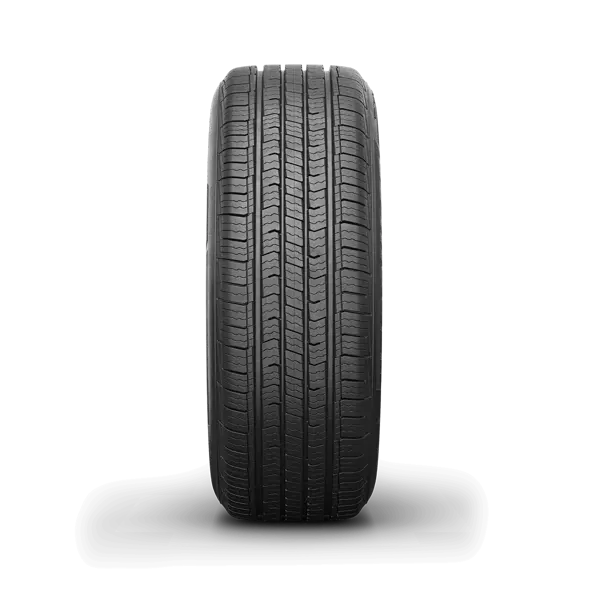
Most cars and SUVs run on All Season tires. They're built for paved roads in all weather — quieter, smoother, better fuel economy, and reliable in rain and light snow.
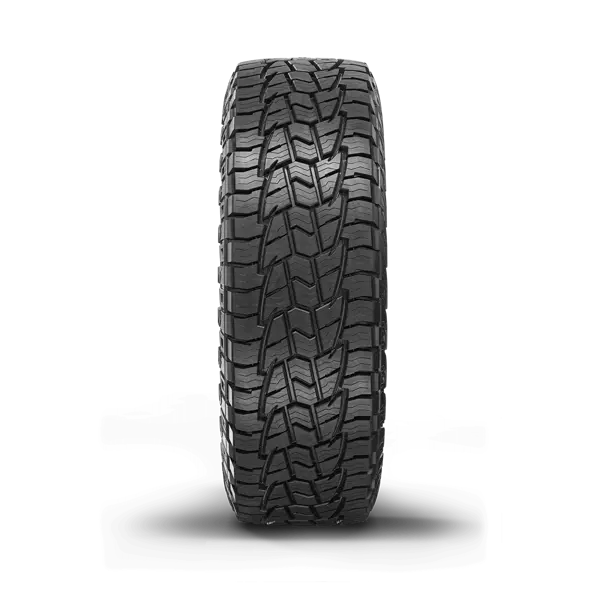
All Terrain tires are built for trucks and SUVs that see dirt, gravel, mud, or deeper snow. More aggressive tread, better grip on loose surfaces, and tougher sidewalls that can take a beating off the pavement.
The trade-off: All Terrain tires are slightly louder on highway, use more fuel, and typically don't last as long on pavement. They're built for capability, not commuting.
Pick All Season if:
- You drive mostly on paved roads
- You want the quietest, smoothest ride
- You want the best fuel economy
Pick All Terrain if:
- You drive on gravel, dirt, or unpaved driveways regularly
- You take your truck or SUV off-road, hunting, or to job sites
- You see heavy snow and want extra grip
Not every tire size comes in an All Terrain pattern — All Terrain is typically only made for truck and SUV sizes. If your size offers both, you'll see both options when you pick a size on the Shop Tires page.
What's the difference between Passenger and LT (Light Truck) tires?
If your tire size starts with plain numbers like 245/75R16, that's a passenger-rated tire (sometimes called "P-metric") — built for cars, crossovers, and most SUVs. Softer ride, better fuel economy, longer treadlife on pavement.
If your size starts with LT like LT245/75R16, that's a light truck tire (LT-metric) — built for half-ton and three-quarter-ton trucks, work vans, and SUVs that tow or haul. Stronger sidewalls, higher load rating, and runs at higher pressure (often 50–80 PSI versus the passenger's 35).
The width, profile, and wheel diameter are identical across the two — what differs is what's underneath the tread: extra plies, tougher rubber, and load capacity that's often 50% higher than the passenger version.
How to know which you need: look at the door jamb sticker on the driver's side. It tells you exactly what size and rating the manufacturer specced for your vehicle.
- If it says LT, use LT. Don't downgrade to passenger — you'll exceed the tire's load rating under a loaded bed or trailer.
- If it specs a plain size, you can stay passenger. Only step up to LT if you regularly tow over half capacity, haul work loads, or run heavy off-road tires.
Why LT costs more: more material, stronger construction, smaller production runs. You're paying for sidewalls that won't fold under a loaded bed and tread blocks that won't chunk on gravel.
When both options exist for your size, our Shop Tires page shows them as separate entries in the dropdown — pick the one that matches your door jamb sticker. Not sure? Bring the truck in and we'll read the sticker together.
What's included when I buy tires from you?
Every tire install at Integrity Tire includes:
- Mount and balance on all four wheels
- Disposal of your old tires
- Rubber valve stems replaced
- Final torque check with a calibrated wrench
- Free rotations for the life of the tires (with the purchase of 4 tires)
- Free patches for the life of the tires
- One year of Integrity Tire road hazard coverage
The price you see on the tier card is per tire. Mount, balance, disposal, valve stems, and torque are all included — no surprise add-ons at the counter.
What does the One Year Road Hazard cover?
For 12 months from the day we install your tires, Integrity Tire road hazard covers damage from things you can't avoid on the road:
- Punctures from nails, screws, and road debris
- Sidewall blowouts from potholes and impact damage
- Curb damage to the tire itself
If we can fix it with a patch, the patch is free. If the tire can't be repaired, the tire is replaced completely free during the first year.
What's not covered:
- Cosmetic wheel/rim damage (the tire is covered, the wheel is not)
- Damage from racing, off-roading beyond the tire's rating, or intentional abuse
- Tires worn below the legal tread depth limit (2/32")
- Vandalism or theft
Filing a claim is easy: just bring the car in. We have your records on file — no paperwork, no phone tree, no insurance company.
Why does my AWD or 4WD need all 4 tires replaced?
If you drive an AWD or 4WD vehicle, this matters — mismatched tires can cause expensive drivetrain damage.
Here's why: AWD and 4WD systems split power across all four wheels. When tires have different tread depths, the wheels actually rotate at slightly different speeds — a tire with deeper tread covers a little more ground per revolution than a worn tire next to it.
Your vehicle's center differential, transfer case, or all-wheel-drive coupling has to constantly work to compensate for that speed difference. Over time, that constant strain wears out those components — and replacing a transfer case can cost thousands of dollars.
That's why every AWD and 4WD manufacturer recommends replacing all four tires at the same time when treads are mismatched, even if only one or two are actually worn out.
If only one tire is damaged and the others are fairly new, sometimes we can match a new tire closely enough in tread depth to be safe. If you're unsure, bring it in — we'll measure your tread and tell you straight whether you need 1, 2, or 4.
What's a wheel lock key and why do I need to bring it?
A wheel lock is a special anti-theft lug nut on one or more wheels per axle. It looks like a regular lug nut from the outside, but it has a unique pattern that only matches a small key — usually a chrome or black socket-style key about an inch long.
If your car came with wheel locks from the factory, the dealership left the matching key somewhere in your car — commonly the glove box, center console, or the trunk's spare-tire compartment.
Why we need it: any service that takes a wheel off — new tires, rotation & balance, tire repair, even some alignment work — requires removing the lug nuts. Without your wheel lock key, we physically can't remove the locked nut. That stops the job in its tracks.
If we discover the missing key mid-service, options get expensive: we can call you to bring it (delaying everyone behind you), order a replacement key from the manufacturer (days), or in worst cases, drill the lock off (which damages the lock and sometimes the wheel).
What to do: when you drop off or arrive for your appointment, leave your wheel lock key in the cupholder so we can find it without searching the car. If you're not sure whether your vehicle has wheel locks, look at one lug nut on each wheel — if any of them looks different from the others (a different shape, pattern, or color), that's the locked one, and there's a key somewhere in your car.
How does drop-off work?
You don't have to wait around. Here's how the no-contact drop-off works:
- Drop your keys anytime in the key drop box to the right of our front door. The box is available 24/7 — before we open, after we close, or during business hours, your call.
- We'll text you a secure payment link when your car is ready — you pay from your phone in under a minute.
- Once payment is made, we text you a locker number and code to retrieve your keys from our key lockers, located across the top of the 24/7 key drop box.
That's it. No waiting room, no phone tag, no chasing us down at closing time. Pick up your car whenever it's convenient for you.
Prefer to wait? You can do that too — the booking flow lets you pick "wait" or "drop off" before you choose a time. Most installs take 45 minutes; alignments run a bit longer.